The cuttings should not be allowed to wilt. Keep on misting the top portion and water the medium regularly, but ensure drainage. Covering the pot/propagation tray with plastic helps provide a warm, humid atmosphere ideal for growth.
Most cuttings can actually take root in water, but water-grown roots are relatively fragile, so extra care should be taken while transplanting them into soil.
Providing warmth
Heating pads may be used to provide bottom heat. It encourages root growth.
Rooting hormones
Hormones can be used to ensure greater success with rooting, but are only necessary with some plants that are difficult to root. An infusion of willow branches can help with rooting. The medium should not contain fertilizers when rooting hormones are used.
The Best Plants To Grow From Cuttings
Although it doesn’t hurt to experiment with growing any plant or herb from cuttings, many annuals that grow readily from seeds may not be worth the effort. The cuttings of some plants, particularly fruit trees that are grafted onto rootstocks, will not grow well even if you manage to force out some roots with the help of rooting hormones. But the following plants give excellent results.
1. Sage – Take 4-inch semi-ripe basal cuttings in fall and pot up. Keep the rooting medium warm and moist throughout winter and then transplant in spring.
2. Thyme – Grow several varieties of thyme from tip cuttings taken in summer and inserted into some moist potting medium.
3. Basil – They are easily grown from seeds, but add to the variety by rooting up tip cuttings taken at any time of the year and kept in a warm, protected place out of direct sun.
4. Rosemary – Take 3-5 –inches long tip cuttings in spring from new growth, or use heel or basal cuttings in fall for rooting in cold frame. If you don’t want a lot of rosemary plants, root a few cuttings directly in individual pots covered with a plastic dome.
5. Lavender – Take 3-inch tip cuttings in early spring and root them in a cold frame. Transplant the rooted plants into garden beds after 4-6 weeks. In summer and fall, heeled cuttings can be taken for spring planting the following year.
6. Horseradish – Lift the root in early spring and cut into 3-inch sections. Plant them a foot apart directly in the garden bed.
7. Comfrey – Dig up a plant and take root cuttings in either spring or fall. Directly plant in a deeply worked bed and cover with mulch. Its roots grow deep into the soil and bring up the nutrients.
8. African violets – To propagate in water place leaf with stem into water, standing up with the creative use of wax paper. Use a rubberband to secure a small section of waxpaper over a glass or jar filled with water. Poke holes in the paper for the stem to stand upright in the water. 2-5 weeks later you should have some roots which can be planted in soil.
9. Rex Begonia – All you need to grow these big-leaved beauties is a single leaf. Make a few slashes on the prominent veins on the underside of the leaf and lay it on a moist bed of peat moss and sharp sand in equal proportions. Weight the leaf down with a few pebbles so that the cut edges remain in contact with the bed. Keep in a warm, well-lit place and watch the new plants appearing at these cut edges.
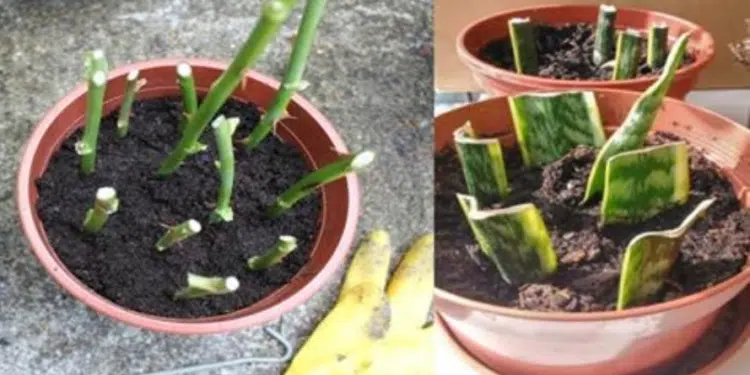
10. Snake plant (Sansevieria) – 2-3 inch sections of the leaf can be used to make new plants. You can thus make a large number of plants from one parent plant. The only problem with this method of propagation is that the new plants will not carry the original variegation. Sections of rhizomes should be planted to retain the variegation.
11. Aluminum plant (Pilea cadierei) – Take tip cuttings with 3-4 nodes. Strip the lowest pair of leaves and trim the stem at that node. Insert into moist rooting medium and keep in a warm place. Keep the medium moist at all times until new growth appears.
12. Coleus – Growing tips, as well as side shoots, arising from the axils of leaves on this plant, will result in new plants. Water the plants very well before snipping off growing tips with 2-4 nodes. Remove the lower leaves and stick into some moist rooting medium. You can insert the cuttings into bottles of plain water, but water-grown plants need extra care while transplanting.
13. Geranium – 6-8 inches long cuttings can be rooted, but it helps if the parent plant is allowed to wilt slightly prior to taking the cuttings. Withdraw water for a week and then take the cuttings 12 hours after watering the plant. The rehydrated stems take root more easily.
14. Philodendrons – You can find a large variety of philodendrons with attractive leaf patterns and colors, but the good news is that all of them are easy to grow from cuttings. Tip cuttings with 2-3 nodes are the easiest to root because they start growing from the tip as soon as the roots form, sometimes even earlier. Mid sections with 2-3 nodes are also good, but it may take some time for new shoots to develop from leaf axils.
15. Jade plant (Crassula) – These fleshy-leaved plants are great for gifting. If you have one plant, you can make several with stem cuttings taken almost any time of the year, as in the case of most houseplants that are tropical in origin. Take 3-4 inch long cuttings with a sharp blade and keep them aside for a week. A good callus formation protects the fleshy stems from rot. Insert the cuttings in a well-draining potting mixture used for succulents. Water occasionally, allowing the potting mix to become nearly dry in between.
16. Chinese evergreen (Aglaonema spp.) – When these plants become leggy, take tip cuttings and pot them up in moist compost and sand potting mix. Keep the soil evenly moist, not wet. Mist the leaves to keep them hydrated until new roots can supply water. Make 3-inch long sections of the remaining stem and lay them horizontally into a tray of moist peat-sand mix. Partially cover the sections with sand and enclose the tray in clear plastic until new shoots start to push through the plastic. Pot up the new plants in individual pots.
17. Dumb cane (Dieffenbachia spp.) – The plants keep losing lower leaves as they grow. Cut off the leafy heads and set them aside for a day or two to form a callus. Pot up in individual containers and keep in a warm place that gets good light. Cut off the remaining bare canes 2 inches above the soil line. Divide these canes into 3-inch sections and place in rooting trays containing peat and compost. Keep covered until shoots come up. Keep the original plant in a warm, well-lit area; it will put up new growth in no time.
18. Ti plant (Cordyline spp.) – These cane-forming plants will eventually grow too tall and lanky. Whenever you feel like pruning your Ti plant, make new plants with the cut branches. Take 1 to 1 ½ ft long growing tips and trim off the lower leaves. Insert into potting mixture in individual pots and keep them in a warm place near a bright window. If any part of the cane is left over, cut it into sections 8-10 inches long. Mark the bottom end of each section by giving it a slanted cut. Insert into a bed of moist soil in the garden.
19. Fragrant Corn plant (Dracaena fragrans) – This one is closely related to Ti-plant, so the propagation method is similar. Tip cuttings and mid-section cuttings can be grown into new plants.
20. Fuchsia – One can never have enough of these beauties; luckily they are very easy to grow from cuttings taken in spring. Tip cuttings with 3 pairs of leaves can be inserted into a moist compost-sand mix and kept covered with plastic to provide humidity and warmth. Plant them out in summer to get flowers in the same season.
21. Hydrangea – Take 4-inch long tip cuttings carrying 3-4 pairs of leaves. Remove the lowest pair and trim the stem closer to the node. Insert into moist rooting medium and cover with plastic sheet. You can trim the larger leaves by 3/4th to reduce water loss through evaporation.
22. Holly – In fall, take 10-12 inch cuttings from a female (one that has borne berries before) bush and wound the bottom one inch. Dip in rooting hormone powder and pot up in some moist rooting medium. Cover with plastic sheeting and keep indoors.
23. Californian tree poppy (Romneya sp.) – Dig up some roots in winter (December) and cut them into 3-inch sections. Lay them horizontally on a tray of moist sand-compost mix. Cover with a glass until shoots appear. Wait until summer to plant them outside.
24. Rose – Take 12-inch long hardwood cuttings of pencil thickness in fall and plant out in the chosen location. Water the cuttings thoroughly until winter.
25. Weigela – Take 5-inch long softwood/semi-ripe cuttings in late spring or early summer and pot up, keeping under a plastic cover. Plant out in early fall. Alternatively, take hardwood cuttings in fall. Root them and overwinter them in a cold frame, until they can be planted outside next spring.


You must be logged in to post a comment Login